Choosing the right floor is one of the highest-impact decisions in any renovation.The types of flooring available today span natural hardwood,engineered planks,luxury vinyl,laminate,tile,stone,carpet,and more—each solving a different problem at a different price point.This guide breaks down the most common types of flooring by material,cost,durability,moisture tolerance,and ideal rooms,so you can narrow your shortlist before requesting quotes.
If you are sourcing flooring at volume for a residential or commercial project,George Group brings 20 years of flooring manufacturing experience,a 130,000㎡factory,and a 48,000㎡showroom to the table—plus one-stop supply across doors,windows,cabinets,tiles,and flooring.
Types of Flooring at a Glance:Cost,Lifespan,and Water Resistance
Before diving into each material,this comparison table gives you a side-by-side view of the most popular types of flooring on the market.
| Flooring Type | Installed Cost (per sq. ft.) | Lifespan | Waterproof? | Best Rooms |
|---|---|---|---|---|
| Solid hardwood | $10–$25 | 50–100 years | No | Living rooms, bedrooms, dining rooms |
| Engineered hardwood | $6–$20 | 20–30 years | Splash-resistant (unless rated) | Living rooms, bedrooms, kitchens over slab |
| Luxury vinyl plank (LVP) | $4–$16 | 15–25 years | Yes (100%) | Any room, including bathrooms and basements |
| Laminate | $3–$8 | 10–25 years | No (unless waterproof-rated) | Bedrooms, living rooms, hallways |
| Porcelain tile | $7–$19 | 50+ years | Yes (when sealed) | Bathrooms, kitchens, entryways |
| Ceramic tile | $2–$10 | 20–30 years | Water-resistant | Low-traffic floors, backsplashes |
| Natural stone | $5–$20+ | 50+ years with care | When sealed | Entries, bathrooms, formal living spaces |
| Carpet | $2–$8 | 8–15 years | No | Bedrooms, family rooms, stairs |
| Bamboo | $5–$15 | 10–25 years | Moderate | Living rooms, bedrooms |
| Cork | $3–$12 | 20–50 years | Water-resistant when sealed | Kitchens, living rooms, home offices |
| Polished concrete | $3–$16 | 50+ years | Yes | Basements, modern living spaces, garages |
Cost figures are planning estimates for materials and professional installation,aggregated from 2026 industry data;actual pricing varies by region,subfloor condition,and specification.
Wood-Based Types of Flooring:Hardwood,Engineered,and Laminate
Wood-look floors remain the most aspirational category,but“wood”covers three very different products.
Solid Hardwood
Solid hardwood is milled from a single piece of lumber—typically oak,maple,or hickory—and can be sanded and refinished 5 to 10 times over a lifespan that often exceeds 50 years,sometimes reaching 100.It adds warmth,natural grain variation that no synthetic can fully replicate,and measurable resale value.The trade-offs are equally clear:solid hardwood is the most moisture-sensitive option,prone to warping in basements and bathrooms,and it sits at the top of the wood-floor price range at$10–$25 per square foot installed.
Best for:living rooms,dining rooms,bedrooms,and any above-grade space where long-term value and authenticity matter more than water resistance.
Engineered Hardwood
Engineered hardwood uses a real hardwood wear layer bonded to a plywood or high-density fiberboard core.This cross-ply construction resists the expansion and contraction that makes solid wood unsuitable for concrete slabs,basements,and rooms with radiant heat.The wear layer thickness determines how many times the floor can be refinished—typically once or twice for 2 mm+veneers—and the total lifespan runs 20 to 30 years.Installed cost lands between$6 and$20 per square foot,making it a middle path between solid hardwood and synthetic alternatives.
Best for:kitchens,living rooms,bedrooms,and installations over concrete or radiant heating where solid hardwood would be too risky.
Laminate
Laminate is a photographic wood or stone image sealed under a clear wear layer over an HDF core.It delivers the lowest installed cost among rigid planks—$3 to$8 per square foot—and offers strong scratch and dent resistance for active households.The critical limitation:standard laminate is not waterproof.Water that reaches the HDF core causes irreversible swelling,so it should be avoided in bathrooms,laundry rooms,and basements unless the product carries a specific waterproof rating.
Best for:bedrooms,living rooms,hallways,and home offices where budget is the primary constraint and moisture exposure is minimal.

Resilient Types of Flooring:Luxury Vinyl,Laminate,and Linoleum
Resilient floors are the workhorses of moisture-prone and high-traffic spaces.
Luxury Vinyl Plank(LVP)
LVP has become the default recommendation for projects that need a wood look without wood’s moisture restrictions.It is 100%waterproof at every price tier,installs as a click-lock floating floor over most existing subfloors,and feels warmer and softer underfoot than tile.Installed costs range from$4 to$16 per square foot,with the wear layer thickness—measured in mils—being the single biggest driver of both price and longevity.A 20-mil wear layer or thicker handles large dogs,rolling chairs,and heavy traffic;thinner 6–12 mil products are budget-grade and better suited to light-traffic rooms.
Best for:kitchens,bathrooms,basements,laundry rooms,pet-heavy households,and any room where moisture is a recurring concern.
Laminate as a Resilient Option
While laminate sits in the wood-look category,its click-lock installation and foam-underlayment comfort profile also make it a resilient-floor contender—particularly for above-grade rooms where the budget will not stretch to engineered hardwood.
Linoleum
Linoleum is made from natural materials—linseed oil,resins,and cork dust—and offers a lifespan of 30 to 40 years,longer than most vinyl products.It is water-resistant rather than waterproof,and its color runs through the full thickness of the material,so wear is less visible than with a surface-printed product.Installed cost runs$7 to$15 per square foot.
Best for:kitchens,utility rooms,and eco-conscious projects where natural materials and long service life are priorities.
Tile and Stone Types of Flooring:Ceramic,Porcelain,and Natural Stone
Tile and stone deliver the highest hardness,the best moisture performance,and the longest service life among hard-surface floors—with comfort and installation complexity as the trade-offs.
Ceramic Tile
Ceramic tile is made from clay fired at a lower temperature than porcelain,resulting in a slightly softer,more porous product.It is easier to cut,more DIY-friendly,and less expensive than porcelain,with installed costs starting around$2 per square foot.The limitation is density:ceramic absorbs more water and is more likely to chip or crack under heavy impact,so it is best suited to dry,low-traffic floors or wall applications rather than wet rooms or busy entryways.
Best for:low-traffic floors,decorative accents,and budget-conscious dry areas.
Porcelain Tile
Porcelain is fired at a higher temperature from more refined clay,producing a denser,harder tile with a water absorption rate of 0.5%or lower—the threshold for true porcelain classification.That density translates into superior scratch resistance,freeze-thaw stability,and suitability for bathrooms,kitchens,mudrooms,and even outdoor patios in mild climates.Installed costs run$7 to$19 per square foot,and a properly installed porcelain floor can exceed 50 years of service.The drawbacks are familiar:hard and cold underfoot,grout lines that need periodic sealing,and installation that demands experience.
Best for:bathrooms,kitchens,entryways,laundry rooms,and high-traffic areas where water and wear resistance are non-negotiable.
Natural Stone
Natural stone—marble,slate,travertine,limestone,and granite—offers a look that manufactured materials cannot fully duplicate,but it is not a single product category.Marble is valued for its veining but can etch and stain;slate brings texture and density variation;travertine has a warm,porous character that requires upkeep;granite is harder and more wear-resistant.Stone demands a stiffer substrate than standard tile,and most varieties require sealing and mindful maintenance to prevent staining and pitting.Installed costs commonly fall in the$5–$20+per square foot range depending on stone type and finish.
Best for:entries,bathrooms,formal living spaces,and projects where natural variation and long-term material character justify the maintenance commitment.
Soft and Specialty Types of Flooring:Carpet,Bamboo,Cork,and Concrete
Carpet
Carpet is the softest,warmest,and quietest flooring option,and it remains the lowest installed-cost choice for bedrooms,family rooms,stairs,and basements with a proper subfloor system.Modern stain-resistant treatments have improved durability,but carpet still traps allergens,absorbs moisture,and typically needs replacement every 8 to 15 years—a shorter investment cycle than hard surfaces.It is best kept out of kitchens,bathrooms,and laundry rooms.
Best for:bedrooms,nurseries,family rooms,stairs,and sound-sensitive spaces.
Bamboo and Cork
Bamboo and cork are the leading eco-friendly“wood-alternative”floors.Bamboo is technically a grass,offers good hardness and dimensional stability,and typically runs$5 to$15 per square foot with a 10–25 year lifespan.Cork is tree bark,delivers cushioning and thermal insulation,and can last 20 to 50 years;it is softer underfoot than bamboo and naturally resistant to moisture when properly sealed.Both are renewable materials with strong sustainability profiles.
Best for:bamboo in living rooms and bedrooms with moderate moisture control;cork in kitchens,home offices,and rooms where standing comfort matters.
Polished Concrete
Polished concrete is mechanically ground and sealed to a smooth,low-maintenance finish.It is exceptionally hard-wearing,efficient with underfloor heating,and has a small carbon footprint compared to most manufactured floors.Residential installed costs range from roughly$3 to$16 per square foot depending on finish level and local labor,and the surface can last decades with minimal upkeep.The aesthetic is industrial-modern,and the floor is cold and hard—area rugs and radiant heat are common companions.
Best for:basements,modern open-plan living spaces,garages,and projects prioritizing durability and low maintenance over softness.
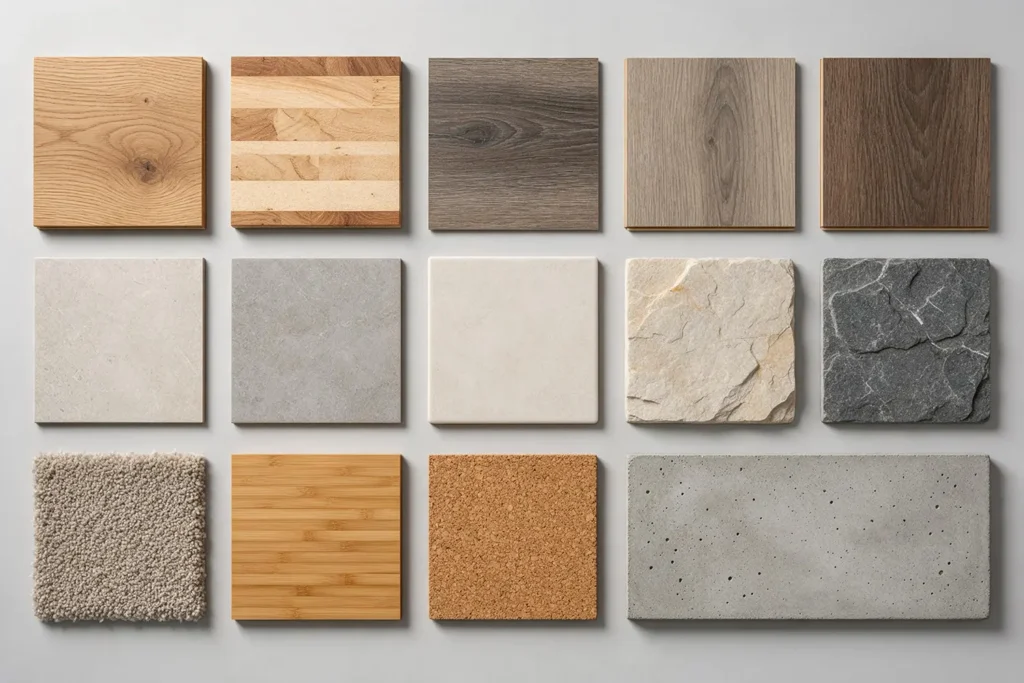
How to Choose Among the Different Types of Flooring by Room
The most reliable way to narrow the types of flooring is to start with the room’s moisture exposure and traffic level.
- Kitchen.LVP or porcelain tile are the safest choices.Both handle spills and frequent cleaning without swelling or staining.Solid hardwood should be avoided near the sink and dishwasher unless you accept the moisture risk.
- Bathroom.Porcelain tile is the top pick for full bathrooms,with LVP as a strong second.Hardwood,standard laminate,and carpet have no place in a wet bathroom.
- Living and dining rooms.Solid hardwood delivers the best resale return,while engineered hardwood and LVP offer the same visual language with more moisture tolerance and lower upfront cost.
- Bedroom.Carpet remains the warmest and quietest option;hardwood,engineered hardwood,and LVP are strong alternatives for allergy-conscious households or buyers planning to sell.
- Basement.LVP is the only wood-look floor that reliably tolerates below-grade moisture.Solid hardwood and standard laminate will swell or warp in a damp basement.
- High-traffic hallways and entryways.Porcelain tile or SPC-core LVP with a 20-mil wear layer handle heavy foot traffic,pet claws,and rolling loads without visible damage.
If you are weighing multiple types of flooring for a whole-home or multi-unit project,the decision often comes down to matching the right material to each room rather than forcing one product everywhere.
Why Source Your Flooring from George Group
George Group has spent 20 years as a flooring source manufacturer,and the scale shows:a 130,000㎡factory and a 48,000㎡showroom mean you can evaluate the actual product—not just a catalog photo—before committing to a specification.Beyond flooring,George Group supplies doors,windows,cabinets,tiles,and other building materials through a one-stop model,which simplifies procurement for contractors,developers,and project buyers who would otherwise coordinate multiple suppliers.
Whether your project calls for engineered hardwood,LVP,porcelain tile,or a mixed-material specification across different types of flooring,George Group’s manufacturing depth and consolidated supply chain are built for volume orders and consistent quality control.Contact George Group to discuss your flooring requirements,request samples,or arrange a showroom visit.
Frequently Asked Questions About Types of Flooring
What are the most waterproof types of flooring?
- Luxury vinyl plank(LVP)and porcelain tile are the most reliably waterproof options.LVP is 100%waterproof at every price tier,and porcelain has a water absorption rate of 0.5%or lower when properly sealed.
What is the most budget-friendly type of flooring?
- Laminate and carpet have the lowest upfront installed costs,typically starting around$2–$3 per square foot for budget-grade products.LVP and ceramic tile occupy the next tier.
Which types of flooring last the longest?
- Solid hardwood and porcelain tile lead on lifespan.Solid hardwood can last 50–100 years with refinishing,and porcelain tile frequently exceeds 50 years.Natural stone and polished concrete also deliver multi-decade service lives with proper care.
Can I install luxury vinyl plank over existing tile?
- In many cases,yes.LVP can float over old vinyl,tile,and even low-pile carpet,provided the existing surface is flat,dry,and structurally sound.The trade-off is a slight increase in finished floor height.
What types of flooring are best for homes with pets?
- Porcelain tile and SPC-core LVP with a 20-mil or thicker wear layer are the most pet-resistant choices.Tile resists claws entirely;rigid-core LVP resists dents and scratches while offering a softer,warmer surface than tile.Solid hardwood and carpet are the least pet-friendly options.
Final Thoughts
The“best”types of flooring do not exist in isolation—the right choice depends on the room’s moisture profile,the household’s lifestyle,the budget,and the intended service life.Solid hardwood and porcelain tile reward long-term thinking;LVP and laminate solve budget and moisture problems;carpet and cork deliver comfort where softness matters;and natural stone or polished concrete anchor spaces where material character and durability carry the design.
For buyers sourcing at scale,the material decision is only half the equation—supply reliability and specification consistency matter just as much.George Group’s 20-year manufacturing base,130,000㎡factory,48,000㎡showroom,and one-stop building-material range are structured to support exactly that kind of project.Reach out to George Group when you are ready to move from comparing types of flooring to specifying and purchasing.