A villa renovation succeeds or fails on material decisions.Paint colors and furniture styles shift every season.Stone,flooring,windows,and cabinetry stay in place for fifteen years or longer.The owners who get the best results from a villa renovation treat material selection as a structural decision,not a decorative one.That shift in thinking changes what you specify,where you source,and how you coordinate the whole package.
Start With Material Honesty,Not Style Labels
The most persistent villa renovation trend for 2027 is not a look.It is a filter for judging materials.Designers describe it as quiet luxury:richness that comes from the character of the material itself rather than from surface decoration.In practical terms,that means solid wood over printed laminate,natural stone over resin imitation,and lime plaster over high-gloss synthetic coatings.
This filter rewards materials that age well.Natural stone develops patina.Solid timber can be sanded and refinished.Honest materials last longer,repair more easily,and waste less over the life of the building.For a villa renovation,that logic matters more than any single aesthetic label,because the material package must survive daily life across multiple rooms and multiple seasons.
The Material Categories That Define a Villa Renovation
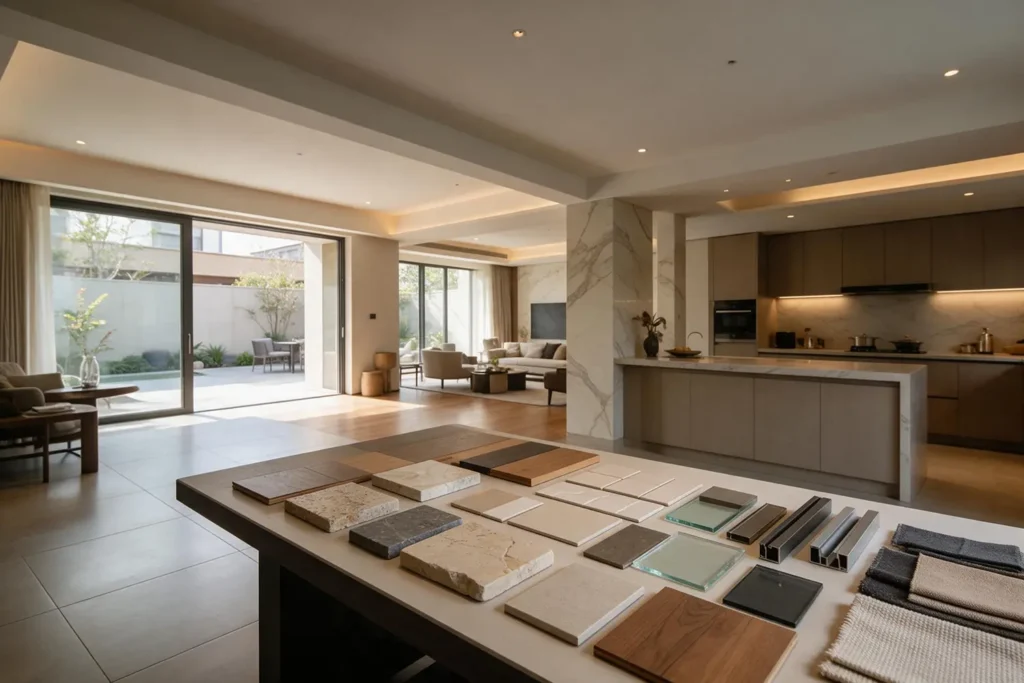
A villa renovation touches six or seven major material categories at once.Each one carries its own specification risk.
Glass doors and windows determine how the villa connects to its site.Large sliding and folding systems bring in light and blur the indoor–outdoor boundary.Thermal performance,wind load,and acoustic rating matter as much as the frame profile.Poorly specified glazing undermines comfort no matter how good the interior finishes look.
Cabinetry carries the heaviest functional load in kitchens,wardrobes,and utility areas.Custom dimensions matter in a villa because standard cabinet depths and heights rarely match the architecture.Moisture resistance and edge sealing separate cabinetry that lasts from cabinetry that swells within two seasons.
Flooring and tiles cover the largest visible surface area.Large-format porcelain,engineered wood,and natural stone each behave differently under foot,under sunlight,and under maintenance.A material that performs well in a bedroom may fail in a sunroom or a wet area.Room-by-room selection beats a single whole-house choice.
Marble and natural stone anchor the perceived quality of entries,staircases,bathroom vanities,and feature walls.Veining and tone vary from block to block.Approval on a small sample does not guarantee a consistent final installation unless the supplier controls the batch.
Lighting and furniture complete the material package.Lighting specification in a villa renovation goes beyond fixture count.It determines how stone,timber,and textile surfaces read at different times of day.Furniture dimensions must fit the rooms the renovation creates,not the rooms that existed before.
Why Coordination Beats Buying Category by Category
Most villa renovation delays trace back to coordination failure.Cabinetry arrives before the flooring is finished.Window lead times push back the interior schedule.Stone from one supplier does not match the tile from another.Each category works in isolation,and the project manager absorbs the gaps.
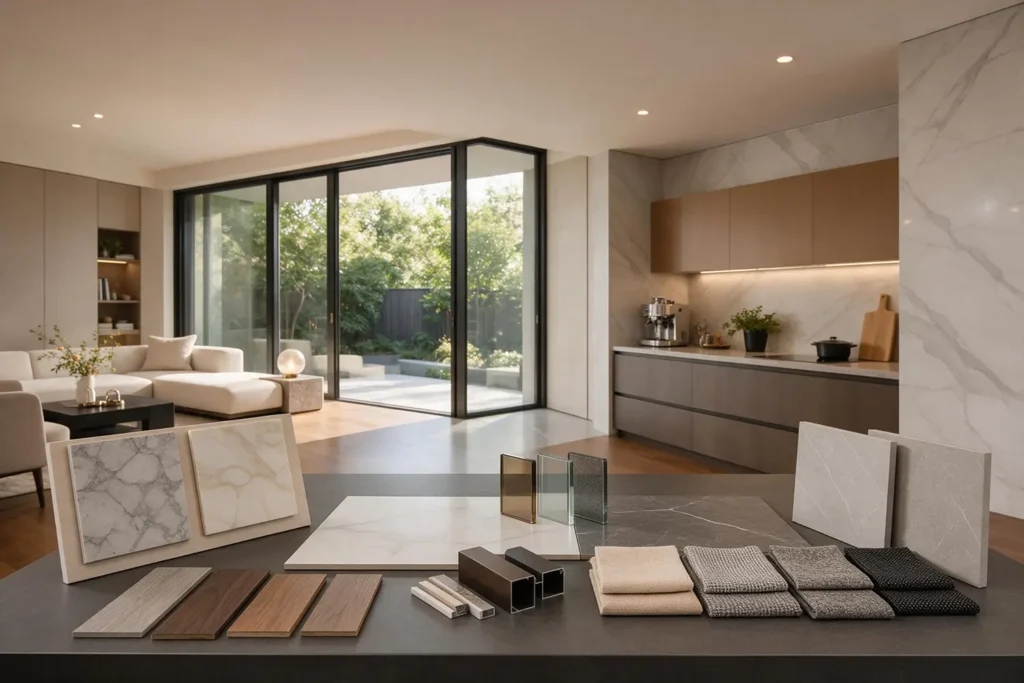
The alternative is to source the material package through one coordinated channel.George Group,a Foshan-based building materials manufacturer,builds its business around that model.The company supplies custom glass doors and windows,kitchen cabinets and wardrobes,flooring,tiles,marble,lighting,and furniture as a single coordinated package for villa projects.The practical difference shows up in specification review:product teams can check how the cabinet finish relates to the floor tone and how the window frame profile works with the interior door system before production begins.
Foshan remains one of the deepest building-material clusters in the world.Sourcing from this region can cut total material costs by 30–50%compared with retail channels in many markets,provided the buyer works with a supplier that controls specification and consolidation.George Group operates a 48,000 m²showroom and a 130,000 m²manufacturing base in Foshan,with completed projects across villas in the Middle East,Oceania,Europe,and North America.For a renovation with fixed handover dates,that consolidation capacity reduces the number of shipments,the number of quality disputes,and the number of suppliers who can blame each other when something arrives wrong.
A Practical Material Checklist Before You Commit
Before you approve a villa renovation material package,run four checks.First,confirm that every custom dimension ties back to the architectural drawings,not to a catalog.Second,ask how the supplier controls batch consistency on stone,tile,and wood finishes.Third,verify that window and door specifications match the local wind,thermal,and acoustic requirements.Fourth,confirm who consolidates the shipment and who handles replacement if a piece arrives damaged.
George Group coordinates those steps for villa owners and project buyers.The company reviews drawings,confirms finishes against the approved scope,manufactures the custom categories,and consolidates the package before shipment.If your villa renovation needs a single source for glass doors,cabinets,flooring,tile,marble,lighting,and furniture,contact George Group to start a material review against your floor plans.