Quick Answer:There is no single“best”wood for every kitchen.The right choice depends on what you value most:durability,finish style,budget,or natural grain character.For painted cabinets,hard maple is the strongest all-around performer.For stained or natural grain,white oak leads in both durability and current design demand.For luxury statement kitchens,walnut delivers unmatched depth of color—if you can accept a softer surface.And for the cabinet box itself,plywood is almost always a better foundation than solid wood or particleboard.
Below,we break down the real differences between cabinet woods and materials,so you can match the right option to your kitchen’s daily demands and design goals.
Solid Wood vs.Engineered Wood:The Decision Most Homeowners Skip
Most“best wood”searches focus on door species—maple,oak,cherry—but the material behind the door matters just as much.In quality cabinetry,the doors and face frames may be solid hardwood,while the cabinet box is often plywood,MDF,or particleboard.
- Solid wood offers natural beauty and can be sanded and refinished for decades,but it expands and contracts with humidity.In a kitchen,that movement can lead to warping or joint separation over time.
- Plywood is made from cross-layered wood plies glued under pressure.It resists moisture better than solid wood,stays dimensionally stable,and holds screws firmly—which is why it is widely considered the best material for cabinet boxes.
- MDF provides a very smooth,uniform surface that takes paint exceptionally well,but it is not as moisture-resistant as plywood and can swell if water reaches the core.
- Particleboard is the lowest-cost option.It is stable and strong in dry conditions but offers the least moisture tolerance and the shortest lifespan among common box materials.
The practical takeaway:a plywood cabinet box paired with solid hardwood doors is the construction standard most custom shops—including George Group—build toward for long-term performance.
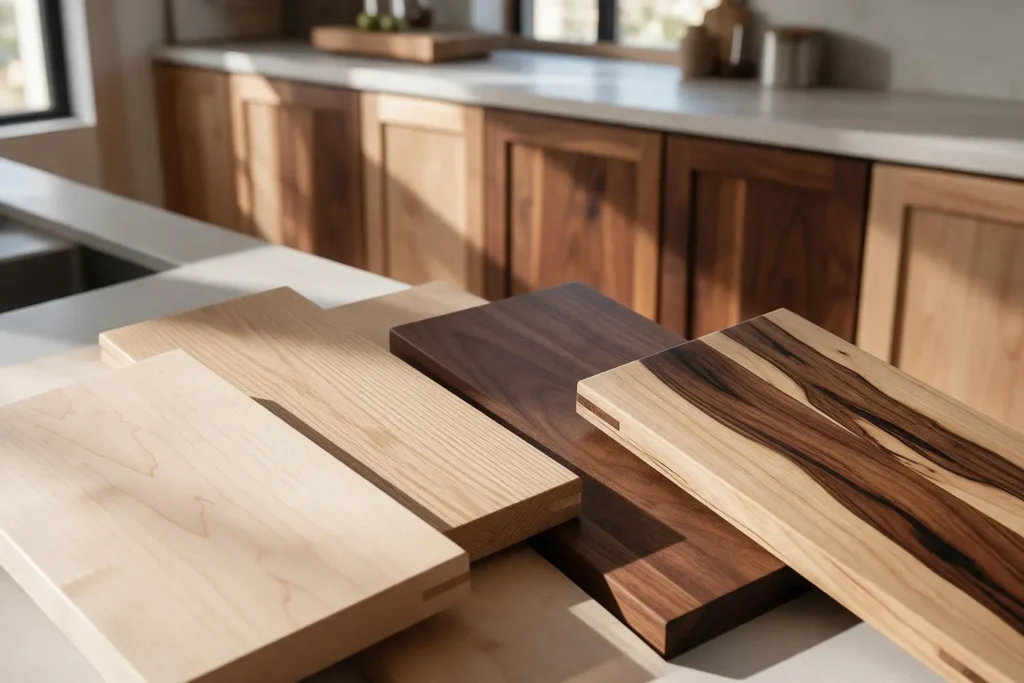
The Main Hardwood Species Compared
Once you are comparing door and front materials,the conversation turns to species.Hardness(measured on the Janka scale)tells you how well a wood resists dents,but it does not tell you how it takes paint,how it ages,or what it looks like under a stain.Those differences matter more than a single number.
Hard Maple:Best Overall for Painted and High-Traffic Kitchens
Hard maple is the densest,tightest-grained wood commonly used in cabinetry,rating around 1,450 lbf on the Janka scale.Its fine,even texture means paint goes on smoothly without telegraphing grain—something open-grained woods cannot promise.
Where it excels:painted Shaker and contemporary doors,busy family kitchens,light natural finishes.
The trade-off:maple can look blotchy under dark stain unless carefully prepped,and it shows dents and scratches more readily than a boldly grained wood like oak because there is no visual texture to hide them.
Best for:homeowners who want a clean,smooth,painted finish and maximum everyday durability.
White Oak:The Best Choice When You Want Grain to Show
Oak has been a kitchen staple for decades,but the conversation has shifted.Red oak is the budget-friendly traditional option with a warm,pinkish tone and bold open grain.White oak is the current design leader—valued for its slightly cooler,more refined color,excellent moisture resistance,and straight grain that works in modern,Japandi,and transitional kitchens alike.
Oak takes stain evenly and darkens beautifully,making the grain a feature rather than a background.It also hides small dings better than smooth-grained woods because the visual busyness of the grain draws the eye away from minor wear.
The trade-off:if you want a perfectly smooth painted finish,oak is not the ideal canvas.Its open grain can show through paint unless the surface is filled first.
Best for:stained or natural-finish kitchens where visible grain is part of the design,especially white oak in modern and organic-style spaces.
Cherry:For Warmth,Elegance,and Patina
Cherry is softer than maple or oak—roughly 950–995 Janka—but it earns its place through character.Its fine,smooth grain takes a natural or light stain beautifully,and over time cherry deepens into a rich reddish-brown patina.That aging process is either the wood’s greatest charm or its biggest drawback,depending on your expectations.
The trade-off:cherry darkens with light exposure,so the color you install will not be the color you see five years later.It also dents more readily than harder species.
Best for:traditional and transitional kitchens,homeowners who see aging as part of the appeal,and projects where a warm,refined tone matters more than maximum dent resistance.
Walnut:The Luxury Statement Wood
Walnut is the most expensive common cabinet hardwood,prized for its rich brown heartwood and elegant,often straight grain.Unlike cherry,which darkens,walnut tends to lighten and mellow toward a warmer honey-brown over time—a distinctly different aging trajectory.
The trade-off:walnut is softer than maple and oak,so it shows dents more readily on drawer fronts and door edges.It is a choice driven by aesthetic priorities rather than maximum toughness.
Best for:luxury modern and statement kitchens,dark natural finishes,and spaces where visual richness outweighs the need for the hardest possible surface.
Hickory and Alder:The Extremes Worth Knowing
Hickory is the hardest common cabinet wood,with a Janka rating around 1,820 lbf.It is exceptionally durable and visually dramatic—sometimes almost chaotic—because the same board can contain light sapwood and dark heartwood.It suits rustic,farmhouse,and natural-finish designs where variation is celebrated,not minimized.
Alder sits at the other end:it is the softest wood in this group and dents more easily,but it delivers real hardwood at a lower cost and takes stain and paint well.It is a sensible budget option for lower-traffic kitchens or painted finishes where maximum hardness is not the priority.
Which Wood Wins for Your Specific Scenario?
The fastest way to decide is to start with your finish and usage pattern,not with a species name.
If you want painted cabinets:choose hard maple.Its tight grain gives the smoothest painted surface and holds up to daily wear in high-traffic kitchens.Painted HDF is a strong engineered alternative for a perfectly stable painted finish,but maple remains the gold standard for solid-wood painted fronts.
If you want stained or natural cabinets with visible grain:choose white oak.It is durable,moisture-resistant,takes stain evenly,and aligns with the warm,modern aesthetic driving current kitchen design.For a more budget-conscious stained kitchen,red oak remains a dependable classic.
If you want a luxury natural finish and accept a softer surface:choose walnut.Its color and grain are difficult to imitate,and the mellowing over time is part of the experience.
If you want maximum dent resistance in a rustic or natural finish:choose hickory.Nothing else in the common cabinet palette matches its hardness and dramatic character.
If budget is the primary constraint but you still want solid wood:consider alder for painted or light-stained doors,paired with a plywood box to maintain structural integrity where it matters most.

From Wood Choice to Finished Cabinetry:Where George Group Fits
Choosing the right wood is the first step.Executing it at scale—with consistent grain matching,precise joinery,and a finish that protects the wood in a working kitchen—is where manufacturing capability and customization experience become decisive.
George Group has spent 20 years building custom kitchen cabinets and wardrobes,with full whole-house customization capability for international project buyers and homeowners.Its factory covers 130,000㎡,and its showroom spans 48,000㎡,giving buyers the opportunity to inspect materials,finishes,and construction in person before committing.
If you are sourcing cabinets or wardrobes for a kitchen renovation,a whole-home project,or a development,and you want a partner who can translate a wood-species decision into production-ready custom cabinetry,George Group welcomes you to visit the factory and showroom for an on-site assessment.Seeing and touching the materials is still the most reliable way to confirm that the wood you choose is the wood you want to live with.
Final Verdict
The“best”wood for kitchen cabinets is the one that matches your finish direction,your tolerance for maintenance and aging,and your budget—not the one with the highest hardness number alone.Hard maple wins for painted durability;white oak wins for stained grain and moisture resistance;walnut wins for luxury character;hickory wins for rustic toughness;and a plywood box is the foundation that makes any of them last longer.Start with the finish and the daily reality of your kitchen,and the species decision becomes far clearer.