Yes—marble floor tile is durable,but its longevity depends far more on specification,installation,and maintenance than on the stone itself.Marble is one of the most hardwearing natural stone flooring options available,and a well-cared-for marble floor can remain in service for 25 years or longer.However,calling marble“durable”without qualification does a disservice to buyers.It is durable in specific ways and vulnerable in others.Understanding that distinction is the difference between a floor that lasts decades and one that looks tired within a few years.
This guide examines what“durable”actually means for marble floor tile,where its limits lie,and how sourcing from the right manufacturer—like George Group,a source factory with 20 years of experience—changes the durability equation from the very first tile.
What Durability Means for Marble Floor Tile
Marble is a metamorphic rock formed when limestone is subjected to immense heat and pressure.That geological history gives it considerable compressive strength and the ability to bear loads without failing.In normal residential and commercial traffic,a properly specified and installed marble floor tile is unlikely to crack or break even in high-traffic areas.
Where the durability conversation becomes more nuanced is in surface performance.Marble is relatively soft compared with granite or porcelain—its primary mineral,calcite,sits at about Mohs 3,softer than glass.This softness means it can scratch,and its calcium-based chemistry means it is susceptible to etching from acidic substances such as wine,coffee,citrus juice,and many common household cleaners.These are real vulnerabilities,but they are surface-level and manageable.They do not mean the tile will fail structurally;they mean the finish requires attention.
The Factors That Actually Determine Whether Marble Floor Tile Lasts
Durability in marble floor tile is not a single property.It is the product of three variables,and weakness in any one of them shortens the floor’s service life.
Stone Quality and Density
Not all marble is equal.Lower-grade or highly porous marble is more likely to crack or break within a few years,especially under heavier foot traffic.Higher-density,well-quarried stone resists wear and moisture penetration more effectively.Porosity varies by marble type,but typical water absorption sits in the 0.4–1.0%range—moderate compared with granite but enough to require sealing.A source manufacturer with control over slab selection can steer projects toward denser,more suitable grades for flooring applications.
Installation Quality and Substrate Stability
Marble floor tile is less forgiving of installation errors than ceramic or porcelain.The substrate must be level,straight,and true,with deflection minimized under load,because movement beneath the tile is a primary cause of cracked stone and failed grout.Marble is also heavier and more difficult to cut and set precisely than many alternative tiles.Skilled installation is not optional—it is a durability requirement.A floor that is poorly bedded will develop problems regardless of how good the stone is.
Sealing and Maintenance Protocol
Because marble floor tile is porous,sealing is not cosmetic maintenance—it is part of the durability system.Without a penetrating sealer,liquids can enter the stone’s pore structure within seconds,causing stains or mineral deposits that are difficult to reverse.Marble floors generally need reapplication of sealer annually,with walls and low-traffic surfaces requiring it every 18–24 months.With that protocol in place,marble can perform reliably for 50–100+years in favorable conditions.Without it,even good stone will etch,dull,and stain.
How Long Does Marble Floor Tile Actually Last?
The honest answer is a range,because durability is conditional.A high-quality marble floor tile,correctly installed over a stable substrate and maintained with regular sealing and pH-neutral cleaning,can deliver 25 years or more of service,with some installations performing well beyond that.Lower-grade stone,poor installation,or neglected maintenance can shorten that timeline considerably—cracking,staining,and loss of finish may appear within a few years.
This is why the question is marble floor tile durable cannot be answered with a simple“yes”or“no.”The material is capable of exceptional longevity.Whether a specific floor achieves it depends on decisions made long before the first tile is laid.
Marble Floor Tile vs.Porcelain:A Fair Durability Comparison
Porcelain tile is often positioned as the more“durable”alternative,and in certain respects it is.Porcelain is harder,has a water absorption rate of 0.5%or less,and its glazed surface resists staining without sealing.It does not etch from acids and generally requires less maintenance.
But the comparison is not one-directional.Marble offers something porcelain cannot replicate:through-body authenticity.The veining in real marble floor tile runs through the full thickness of the stone,so cut edges and mitered corners reveal the same continuous pattern.Marble also develops a patina over time—a surface character that many designers and homeowners consider an asset rather than a defect.Porcelain can imitate the look,often convincingly,but it remains a printed reproduction near the surface.
For projects where a specific stone aesthetic,tactile depth,and long-term character are priorities,marble’s durability profile is entirely workable with the right specification and care.For high-moisture,high-traffic spaces where minimal maintenance is the overriding requirement,porcelain may be the more practical choice.Neither answer is wrong;the decision turns on the project’s priorities.
Why the Manufacturer Matters:George Group’s 20-Year Source-Factory Advantage
The durability of marble floor tile begins with the stone itself—its density,its grading,and how it is cut and finished.That is why sourcing from an experienced,vertically integrated manufacturer matters more than buyers often realize.
George Group has 20 years of experience as a marble floor tile manufacturer.That two-decade track record is not a marketing line;it represents accumulated knowledge of which stone types perform best in which applications,how to select slabs that will hold up under traffic,and how to finish tile surfaces to support long-term sealing and maintenance.For project buyers,that experience translates into lower risk—fewer surprises after installation,fewer callbacks,and a floor that meets its durability potential.
Because George Group is a source manufacturer,buyers also avoid the markup layered in by trading companies and intermediaries.The price reflects manufacturing cost rather than distribution margin,giving George Group a structural pricing advantage that resellers cannot match.Direct factory sourcing does not just reduce cost;it shortens the communication chain between the buyer’s requirements and the production floor,which matters when specifications need to be precise.
Visit the Factory and Showroom Before You Specify
Marble is a specification-sensitive material.The only way to confirm that a manufacturer’s marble floor tile meets your durability and aesthetic requirements is to see it,feel it,and compare it in person.
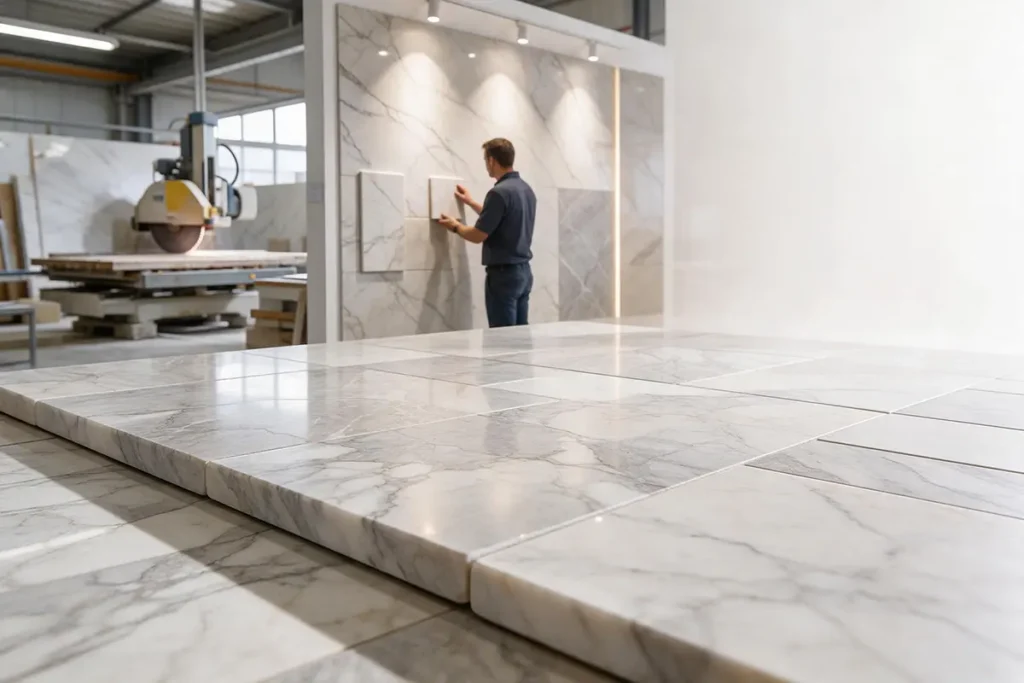
George Group operates a 130,000 m²factory and a 48,000 m²showroom,and welcomes clients to visit both.In the showroom,buyers can walk through full-scale marble floor tile displays,compare finishes and veining patterns side by side,and select the styles that suit their project.On the factory tour,visitors can observe the production environment,slab handling,cutting and finishing processes,and quality-control procedures.For international buyers planning a sourcing trip to Foshan,a factory visit provides direct verification of capacity and workmanship—and the opportunity to discuss specific durability requirements with the production and technical team.
Key Takeaways
- Marble floor tile is durable,with high-quality,well-installed floors lasting 25 years or longer;some perform well beyond that with proper care.
- Durability is conditional:it depends on stone quality,installation over a stable substrate,and regular sealing and maintenance.
- Marble is softer and more acid-sensitive than porcelain,so it requires more attention—but its through-body authenticity and patina cannot be replicated.
- George Group brings 20 years of source-manufacturing experience to marble floor tile production,with a 130,000 m²factory and 48,000 m²showroom.
- Buying factory-direct eliminates intermediary margins,delivering a pricing advantage that resellers cannot match.
- Clients are invited to visit the factory and showroom to verify stone quality,compare styles,and confirm specifications before committing to a project order.