Finding the right place to buy hotel furniture is not a simple price comparison exercise.A hotel project operates on a fixed opening date,and every furniture decision carries operational consequences—a missed delivery window costs nightly revenue,not just a delayed shipment.The supplier you choose must deliver on specification,certification,volume consistency,and timeline simultaneously.
This guide walks through what to evaluate before you commit,and explains how a vertically integrated supplier like George Group fits into that evaluation.
What to Settle Before You Start Comparing Suppliers
The most common sourcing mistake is approaching suppliers before your own requirements are written down.A clear brief produces comparable quotes;a vague one produces quotes that look alike but cover entirely different scopes.
At minimum,your hotel furniture brief should include:
- Room count and room types,plus public-area scope.
- An FF&E schedule—a line-by-line list of every item with dimensions,quantities,material specifications,and reference images.
- Certification requirements for your market.BIFMA is the baseline for US institutional buyers;ISO 9001 is preferred across Europe,the Middle East,and Asia.Upholstery on commercial-grade hotel furniture typically needs a Martindale rub count of 50,000 or higher,with a one-to-two-year minimum frame warranty.
- Fire-retardancy standards specific to the destination market.A rating that satisfies one country’s code does not automatically satisfy another’s.
Without these inputs,supplier conversations stay at the showroom level—and showroom appearance alone is a poor predictor of production capability.Any factory can refine a single display piece;repeating that quality across hundreds of identical rooms is a different test.
How to Evaluate Where to Buy Hotel Furniture
Once the brief is ready,the evaluation shifts from“who sells hotel furniture”to“who can be trusted to deliver it at scale.”Four signals separate viable suppliers from risky ones.
1.Manufacturing evidence,not showroom evidence
A large showroom reflects commercial investment,but it does not prove production capacity.Buyers should confirm who actually manufactures the products,where production takes place,and whether any processes are outsourced.A supplier that operates its own manufacturing facility and welcomes factory visits is materially different from a trading company with a display floor.Factory scale—measured in production area,equipment,and staffing—tells you whether the supplier can absorb your volume without subcontracting quality away.
2.Certification and test documentation
For a significant hotel furniture order,request the actual test reports rather than relying on catalogue claims.A genuine report names the testing laboratory,the specific standard,and the result.If a supplier cannot produce documentation behind a durability or fire-rating claim,treat that as a real gap to resolve before ordering.
3.Reorder consistency and spare-part support
Hotel furniture is not a one-time purchase.Housekeeping damage,phased renovations,and attic stock requirements mean you will return to the same specification later.Ask whether pre-approved fabrics,hardware,and finishes can be reliably reproduced on future orders.A supplier that cannot guarantee reorder consistency creates a hidden cost in every future replacement cycle.
4.Scope coverage across the whole project
Most hotel projects require more than guestroom furniture.Lobby seating,reception desks,casegoods,lighting,and even building materials all sit inside the same delivery window.Coordinating multiple suppliers multiplies the risk of mismatched lead times and inconsistent quality checks.A supplier that covers furniture and adjacent categories under one roof reduces that coordination burden—and gives you a single point of accountability.
Where George Group Fits in the Hotel Furniture Supply Chain
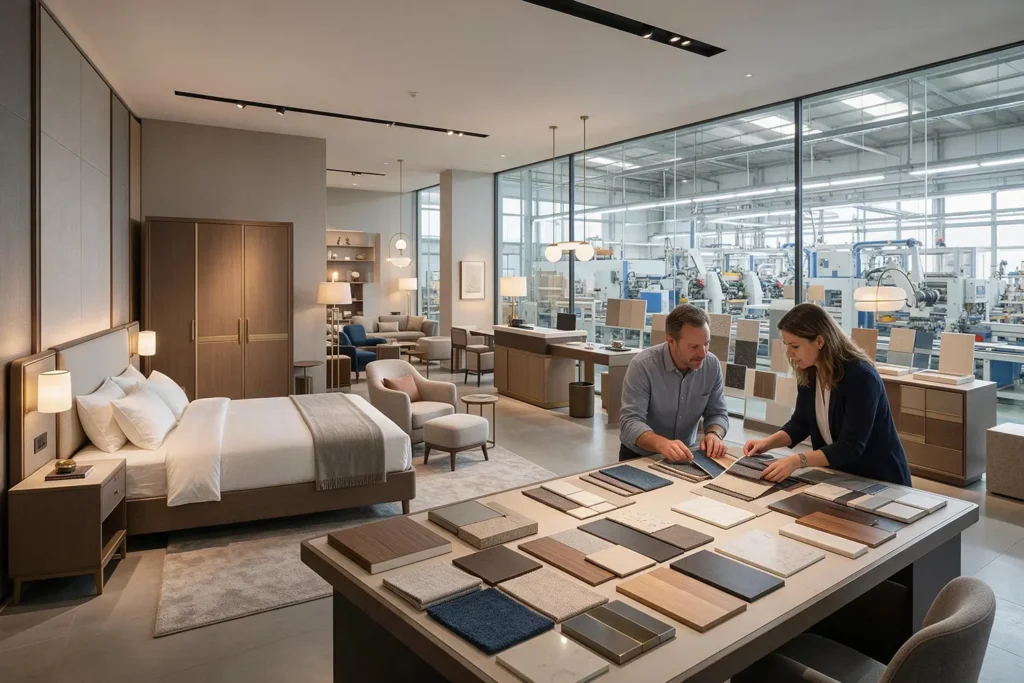
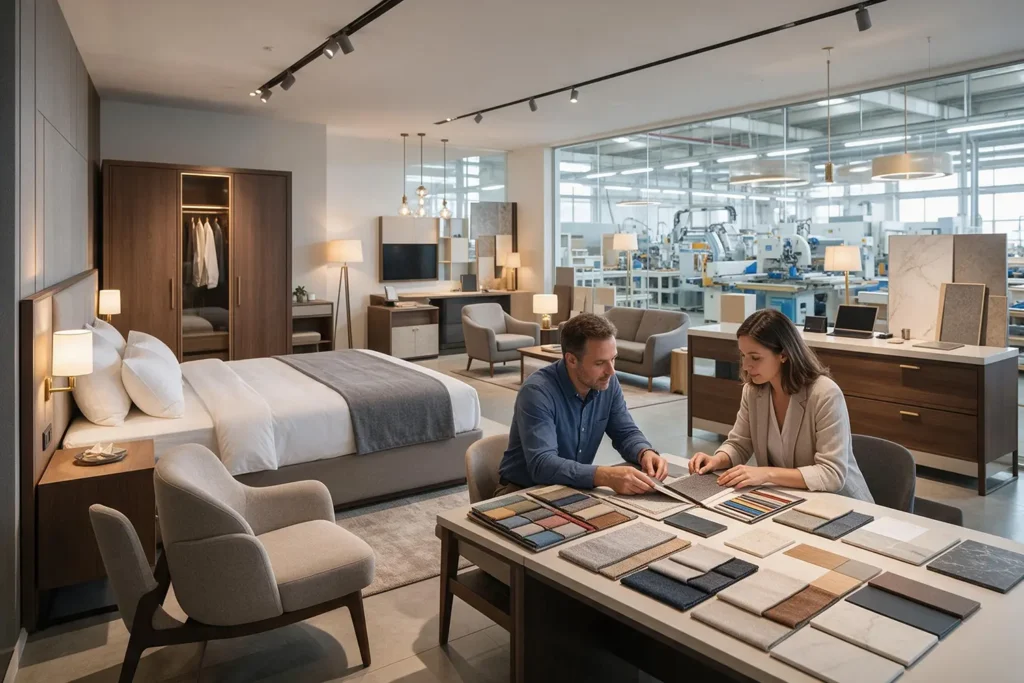
George Group is a Foshan-based hotel furniture supplier built around a factory-direct,multi-category model.The operation runs a 130,000 m²manufacturing park alongside a 48,000 m²showroom,with the two located close enough to visit in a single trip.For buyers who cannot fly out for every audit,that proximity matters:it means the sample you approve in the showroom and the production line that will build it are the same operating entity,not disconnected stages of a supply chain.
Compare everything in one place
The practical advantage of a 48,000 m²showroom is that hotel furniture does not get evaluated in isolation.Buyers can compare finishes,materials,and product options across categories side by side,rather than piecing together a specification from separate catalogues and hoping the tones and textures align.This is where hotel furniture decisions become project decisions:the bed frame finish,the lobby chair upholstery,the casegoods laminate,and the lighting fixture can all be assessed against the same reference point.
Furnish the space,not just the room list
George Group supplies hotel furniture as part of a broader FF&E and building-materials offer.Beyond guestroom and public-area furniture,the range extends to other furniture categories and construction materials,allowing a project to consolidate what would otherwise be multiple supplier relationships.For a hotel buyer,that consolidation has a direct operational value:fewer handoffs,fewer specification mismatches,and a shorter path from approval to shipment.
The factory-direct model removes intermediary layers.In comparable sourcing structures,stripping out trading-company margins has been shown to land full hospitality fit-outs at substantially lower cost for identical specifications,with the saving scaling on custom work.Combined with the ability to compare all product categories in one showroom visit,the result is a procurement process that is simpler to manage,easier to control,and more predictable on budget.
Common Questions Buyers Ask About Hotel Furniture Suppliers
Do I need to use my brand’s approved vendor list?For branded properties,check the franchise or management agreement.Some brands require approved-vendor sourcing for guest-facing hotel furniture;others only require the furniture to meet technical standards regardless of source.Either way,the supplier must be able to document compliance.
What certifications should I ask for?At minimum,BIFMA for US-bound projects and ISO 9001 as a baseline quality-management credential.For upholstered hotel furniture,confirm fire-retardancy testing against the destination market’s code.
How do I avoid a showroom-only supplier?Ask to visit the production floor,not just the display area.Review the factory’s production area,equipment list,and quality-inspection records.A supplier that only permits showroom visits is telling you something important about where the value is actually created.
Can I buy hotel furniture and other FF&E from the same supplier?Yes—and for many projects,that is the more efficient route.Consolidating furniture and adjacent categories under one specification and one shipment plan reduces freight cost per unit and keeps quality control under a single standard.
The Bottom Line
The right place to buy hotel furniture is the supplier that can show you the factory behind the showroom,the test report behind the claim,and the reorder process behind the first order.George Group’s combination of a 130,000 m²manufacturing park and a 48,000 m²multi-category showroom is designed for exactly that kind of scrutiny—so buyers can compare products,verify production,and consolidate hotel furniture and building-material needs in one visit,without paying for layers that do not add value.
If your project has a fixed opening date and a specification that cannot afford surprises,start with a supplier whose factory and showroom are built to be compared.