Quick Answer:A properly installed and maintained marble floor tile floor typically lasts 25 to 50 years in residential settings,with many installations exceeding that range.In commercial or high-traffic environments,the expected lifespan is shorter unless the specification and maintenance program are adjusted accordingly.The difference between a floor that lasts two decades and one that lasts five comes down to three variables:material quality,installation discipline,and ongoing care.
The Short Answer:How Long Does Marble Flooring Last?
Published lifespan figures for marble flooring vary because“marble”covers a wide spectrum of stone grades,tile thicknesses,and installation conditions.The most consistent baseline from industry sources is:
- Residential marble floor tile:25+years with proper care,often improving in appearance over time rather than simply wearing out.
- High-quality marble with diligent maintenance:50 years or longer in residential hallways,living rooms,and other moderate-traffic areas.
- Commercial or heavy-traffic applications:Lifespan drops significantly unless the marble is specified with denser stone,thicker tile,honed finishes,and a more aggressive sealing and restoration schedule.Some suppliers explicitly advise against standard marble floor tile in heavy commercial lobbies,recommending granite or porcelain instead.
The practical takeaway:marble floor tile is a long-life material,but“long”is a range,not a fixed number.The range exists because the stone itself is only one part of the equation.
What Separates a 25-Year Floor from a 50-Year Floor?
Four factors consistently determine where a marble installation lands within that lifespan spectrum.
1.Stone Grade and Thickness
Lower-grade marble is more likely to crack,chip,or break within a few years,especially under heavier foot traffic.Higher-grade blocks with tighter grain structure and fewer structural flaws hold up far better.Thickness matters as well:residential marble floor tile commonly ranges from¼inch to¾inch,while commercial marble slabs can be up to 2 inches thick.Thicker stone tolerates minor substrate movement and point loads more gracefully.
2.Sealing:The Single Most Controllable Variable
Marble is porous and calcium-based.Without sealing,it absorbs water,oils,and acidic substances,leading to staining and etching.The sealing protocol for a long-life marble floor tile installation is straightforward but non-negotiable:
- Seal immediately after installation.
- Reseal every 1–2 years in normal residential conditions;more frequently in wet areas or busy households.
- Use an impregnating sealer rather than a surface coating,so the stone can still breathe while being protected from within.
A marble floor that is never sealed will not necessarily disintegrate,but it will stain,dull,and etch far sooner,and restoration costs will erode the economic case for the material.
3.Installation Quality
Marble does not forgive installation errors the way ceramic or porcelain can.Uneven substrates,incorrect adhesives,and inadequate moisture control shorten the life of a marble floor tile installation dramatically.The substrate must be flat,primed,and—critically—dry.Marble tiles should be installed over a moisture-resistant underlayment such as cement board,and the setting materials must be compatible with calcium-based stone.
4.Finish Selection by Location
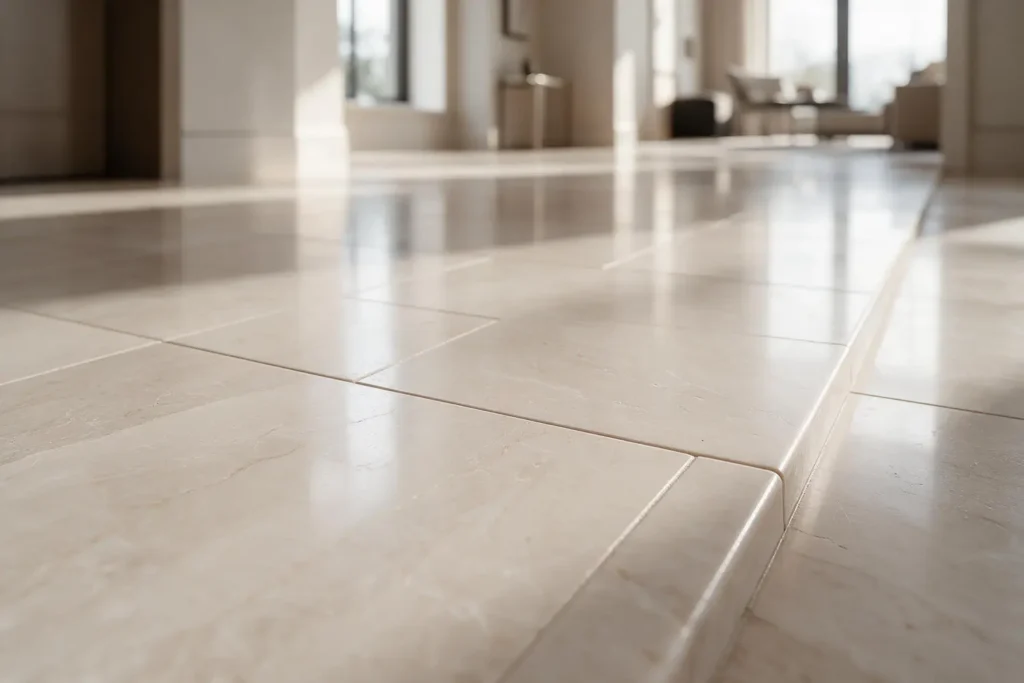
Polished marble is stunning in dry,formal areas.In wet zones or high-traffic paths,a honed finish is the more durable choice:it shows less wear,provides better slip resistance,and hides superficial scratches more effectively than a high-gloss surface.Matching the finish to the room is not a design preference—it is a lifespan decision.
Residential vs.Commercial:The Lifespan Gap
It is tempting to treat“marble floor lifespan”as a single number,but the application context changes the calculus.
| Application | Typical lifespan with proper care | Key specification notes |
|---|---|---|
| Residential living areas, hallways | 25–50+ years | Polished or honed; annual sealing sufficient |
| Residential bathrooms, kitchens | 20–30+ years | Honed finish preferred; seal every 6–12 months in wet zones |
| Boutique retail, light commercial | 15–25 years | Denser stone, thicker tile, professional restoration program |
| Heavy commercial lobbies, transit zones | Often not recommended for standard marble | Granite or porcelain is the more rational specification |
The distinction is not about marble“failing.”It is about wear rate.In a home,a marble floor tile surface may see a few thousand footsteps per year.In a hotel lobby,it can see that volume in a week.The stone is the same;the maintenance and restoration intensity required to keep it serviceable is not.
How Maintenance Extends Marble Floor Tile Life
Maintenance is where the lifespan range is won or lost.A marble floor that receives consistent,correct care will outlast one that receives occasional deep cleaning by a wide margin.
Daily and weekly care.Dust-mop or vacuum with a soft brush or microfiber head to remove grit before it acts as an abrasive underfoot.Damp-mop with a pH-neutral stone cleaner;avoid ammonia,bleach,vinegar,and acidic bathroom cleaners,all of which etch calcium-based stone.
Spill response.Blot—do not rub—wine,coffee,citrus juice,oil,or pet accidents.The longer an acidic substance sits on polished marble,the deeper the etch mark and the more costly the restoration.
Periodic restoration.Professional honing and polishing every few years removes surface scratches and renews the finish.Restoration performed by trained technicians can add 10–15 years to the surface lifecycle of a marble floor.Compared with the cost of replacement,periodic restoration is a fraction of the expenditure:polishing typically runs a few dollars per square foot,while full replacement involves material,labor,and downtime.
Resealing discipline.This is the maintenance task most often deferred and most directly linked to premature aging.A marble floor tile floor that is resealed on schedule resists staining and retains its finish far longer than one where sealing is treated as a one-time event.

When Marble Floor Tile Is the Right Investment—and When It Is Not
Marble floor tile is a rational choice when the project prioritizes longevity,aesthetic depth,and the capacity for restoration.Natural marble cannot be“worn through”in the way a thin glaze or printed porcelain surface can;it is solid stone through the body of the tile.When it dulls,it can be polished.When it scratches,it can be honed.That renewability is the structural reason marble floors in historic buildings have survived for generations.
It is a less rational choice when the application involves heavy commercial abrasion,exposure to concentrated acids,or an owner who is unwilling to commit to a sealing and neutral-cleaning regimen.In those cases,the honest answer is that a different material will deliver a lower total cost of ownership over the same service life.
For projects that do fit marble,the specification decision matters as much as the maintenance decision.Batch tone consistency,calibrated thickness,and finish control are not marketing details—they determine whether the installed floor performs as a unified surface or as a patchwork of mismatched tiles.
Sourcing Marble Floor Tile with Confidence
The lifespan of a marble floor tile floor begins long before installation.It begins with the block,the cutting line,and the quality control at the factory gate.
George Group has spent 20 years in the stone and building materials trade,operating a 130,000 m²factory and a 48,000 m²showroom in Foshan,China.That scale is not incidental to the lifespan question.It means the marble floor tile you specify can be cut from a contiguous set of blocks,with batch tone control and consistent calibration across the entire order—the variables that decide whether an installer can lay a floor that performs as one continuous surface rather than a mixed-lot compromise.
If you are sourcing marble floor tile for a residential project,a hospitality installation,or a commercial development,the George Group team can work from your drawings,BOQ,or material schedule.The factory-direct model removes the retail markup that inflates marble pricing without improving the stone,and the showroom allows buyers to inspect finish,veining,and thickness before committing to a production run.
To discuss your marble floor tile requirements and receive a factory-direct quotation,contact George Group.Share your project area,tile format,finish preference,and destination,and the team will respond with specification guidance and pricing.
Final Takeaway
The lifespan of marble floor tile is not a single number waiting to be looked up.It is an outcome shaped by stone grade,thickness,sealing discipline,installation quality,finish selection,and the consistency of maintenance.A residential marble floor can reasonably be expected to serve 25 to 50 years or more;a commercial installation requires a tighter specification and a more intensive care program to approach the same service life.
The material has already proven it can last—historic marble floors are still in service after centuries.The variable is not the stone.It is the decisions made before and after it is laid.